




Home > The news of EUROGIP and occupational risks in Europe >
Following decabromodiphenyl ethane (DBDPE) from last November, the European Chemicals Agency (ECHA) has identified n-hexane and bisphenol AF and its salts as substances of very high concern (SVHC) that may harm human health or the environment.
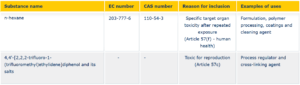
These substances are used in particular in formulations, the processing of polymers (rubber, plastics, etc.), coatings, cleaning agents, and as process regulators or cross-linking agents.
n-hexane is identified as a substance with neurotoxic properties for which there is scientific evidence of probable serious effects on human health; raising a level of concern equivalent to that of the substances listed in Article 57(a) to (e) of the REACH Regulation.
bisphenol AF and its salts are considered toxic to reproduction in accordance with Article 57(c) of the above-mentioned regulation and are classified in category 1B “toxic to reproduction” (H360F: “May impair fertility”).
Once these substances have been identified as “substances of very high concern,” they are added to the Candidate List. This classification entails immediate obligations for companies that directly supply the substance, a mixture, or an article containing it. They are required to:
- provide a safety data sheet;
- provide sufficient information for safe use;
- respond to consumer inquiries within 45 days;
- notify ECHA if the article produced contains a substance of very high concern in quantities exceeding one ton per producer/importer per year and if the substance is present in these articles in a concentration exceeding 0.1% weight/weight (w/w).
- implement and recommend risk management measures to minimize exposure and emissions to humans and the environment, which downstream users must apply (for PBT and vPvB substances).
With the addition of these two substances, the list now contains 253 entries.


