




Home > The news of EUROGIP and occupational risks in Europe >
On Tuesday 6 October 2026, the European Parliament adopted a legislative initiative report on psychosocial risks (PSRs), stress and mental health at work.
Adopted with 413 votes in favour, 210 against and 29 abstentions, this text calls on the European Commission to draw up a legislative proposal “to prevent, eliminate or reduce work-related psychosocial risks that can lead to work-related stress, burnout, and mental and physical disorders”.
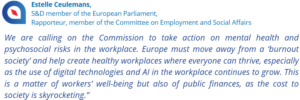
At European level, there are currently a large number of provisions relating to health and safety at work, but no legislation specifically addresses the prevention and management of psychosocial risks in the workplace.
The Commission has three months to respond to the Parliament’s request, either by informing it of the measures it intends to take or by giving reasons for any refusal to propose a legislative initiative.
The Parliament’s recommendations
In practice, the European Parliament is calling on the Commission to draw up a proposal that would include several specific points, amongst which:
Common official definitions
To date, there are no standardised definitions at European level for a number of terms relating to mental health at work. Parliament is therefore calling for certain terms to be officially defined, such as “work-related psychosocial risks”, “work-related stress” and “moral distress”.
Regular assessment of psychosocial risks by employers
The Members of Parliament advocate regular assessments of psychosocial risks by employers and the adoption of action plans accompanied by concrete measures. A preliminary assessment, carried out in collaboration with employees and their representatives, should be conducted prior to any major restructuring or reorganisation of work, particularly in the event of changes to remote working arrangements, staffing levels, or the introduction of automated decision-making and monitoring systems.
The right to disconnect
The Parliament believes that workers should be able to exercise their right to disconnect and that employers should respect this right, except in exceptional circumstances, as set out in the European Parliament resolution of 21 January 2021 on the right to disconnect.
Establishing a service for the prevention and protection against psychosocial risks
Employers should be able to designate one or more workers to carry out activities relating to the monitoring and assessment of risks, as well as the early detection, prevention and management of psychosocial risks within the company or establishment. If the company does not have sufficient competent staff, it should be able to call upon the services of competent external organisations or individuals for this purpose.
Supporting a sustainable return to work
Workers who have been absent from work for a prolonged period or on several occasions due to health problems linked to psychosocial risks should be entitled to a sustainable return to work, supported by appropriate measures.
To this end, the employer should put in place a personalised return-to-work plan, drawn up in particular in collaboration with the worker concerned. This plan should include measures such as adjustments to tasks or workload, changes to working hours, and any other measures aimed at tackling the psychosocial risks that have had a negative impact on the worker’s health.
Focus on the recognition of psychosocial risks as occupational diseases
According to the Parliament’s press release, the Members “also want the Commission and EU-countries to recognise explicitly that work-related psychosocial risks give rise to occupational diseases.”
It should be noted that Recommendation No. 16, which sought to introduce a legal presumption, was as follows in the report originally presented in September:
Recommendation 16
Legal presumption
1. Member States should ensure that, where a worker establishes facts indicating exposure to work-related psychosocial risk factors and an injury or damage to health consistent with such exposure, it is presumed that the impairment is work-related, unless the employer demonstrates that the injury or damage to health is not linked to the worker’s working conditions.
2. Member States may provide for more favourable provisions for workers, including mechanisms for the alleviation of the burden of proof subject to legal certainty and the prevention of abusive and manifestly ill-founded claims.
In the report adopted by Parliament in October, the first paragraph of this recommendation was removed, along with any explicit reference to a “legal presumption”.
Sources:
- European Parliament press release dated 6 October 2026 “Parliament wants better protection of workers’ mental and physical health”
- European Parliament resolution of 6 October 2026 containing recommendations to the Commission on psychosocial risks, stress and mental health at work (2026/2023(INL))
- Explanation of the Parliament’s right of legislative initiative
For further reading on psychosocial risks:


