



Studies & Surveys

Every year, EUROGIP conducts studies and surveys on occupational risk insurance and prevention in Europe. Based on in-depth research and international comparisons, these studies provide unique insights into the practices, policies, and measures implemented in various European countries to improve occupational health and safety.
Latest Studies & Surveys
2015
Occupational Risks Insurance in Poland
EUROGIP publishes a new document that presents a descriptive overview of the occupational risks insurance of Poland. It deals with its operating modes and a statistical chapter details the accidents at work and occupational diseases data.


2015
Reporting of occupational diseases: issues and good practices in five European countries
EUROGIP publishes a report entitled “Reporting of occupational diseases: issues and good practices in five European countries”. These countries – Germany, Denmark, Spain, France and Italy – were chosen because they are representative of diverse but mature insurance models and four of them (except Germany) show an interest in the issue of under-reporting of occupational diseases.
The study is organized around these issues:
- an overview on reporting occupational diseases procedures
- comparative statistics (2011) concerning main reported and recognized occupational diseases (MSDs, hypoacusia, dermatosis, cancers)
- a focus on under-reporting of occupational diseases with an assessment each country makes of the shortcomings of its system and the solutions experimented successfully to correct them.
2015
Statistical review of occupational injuries – FRANCE 2014 data
Within its set of statistical data relating to accidents at work and occupational diseases in the European Union Members States, EUROGIP publishes the 2014 data for France (Private sector).
2014
Statistical review of occupational injuries – FRANCE 2013 data
Within the set of statistical data relating to accidents at work and occupational diseases in the European Union Members States, EUROGIP publishes the 2013 data for France (Private sector).
The number of recognized accidents at work, with at least 1 day off work, declined from 720,150 cases in 2007 to 618,263 in 2013. The number of fatal accidents has also declined since 2007 from 622 to 541 cases. Commuting accidents accounted for 93,363 cases incurring at least one day off work. There were 306 fatal commuting accidents.
As for the number of recognized occupational diseases, it falls, from a peak of 80,331 cases in 2011 to 68,120 cases in 2013.
2014
Note on a new EU Strategic OSH Framework 2014-2020
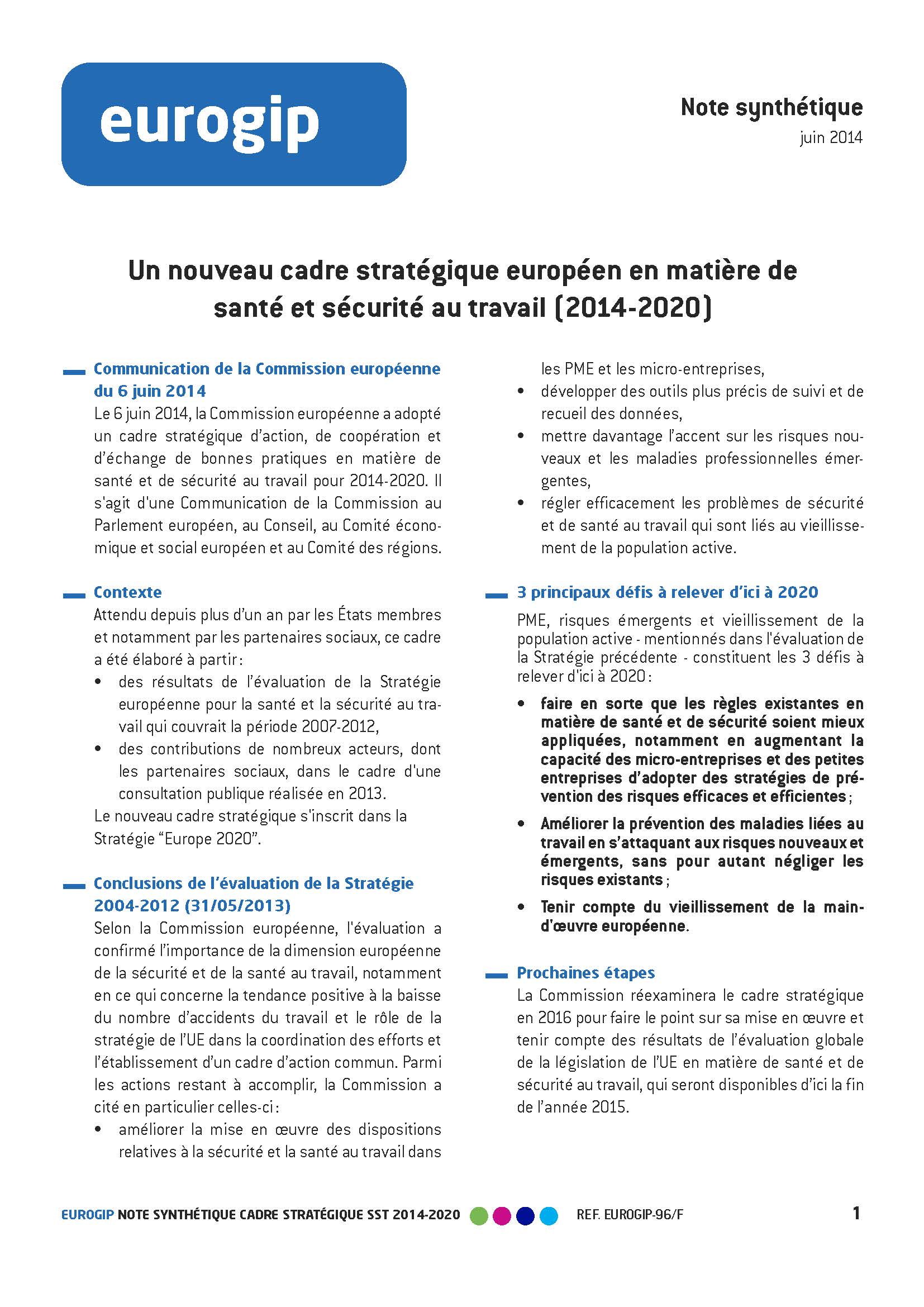 EUROGIP provides a summary note on the new strategic framework on health and safety at work covering 2014-2020 published by the European Commission on June 6. A table is used in particular to see the 7 cross-cutting strategic objectives, actions to be taken and stakeholders concerned.
2014
Encourage companies to prevent occupational risks: which devices in Europe? – Eurogip Discussions’ proceedings on March 2014
EUROGIP publishes the proceedings of the conference organized on March 20, 2014 on the devices in Europe to encourage companies to prevent occupational hazards.
Stakeholders from seven European countries presented various examples of incentives, including:
- Funds in Italy (INAIL), endowed with € 300 million in 2014 to finance projects of small and very small in order to improve health and safety at work;
- A bonus system in Germany proposed in the meat sector of the insurance against occupational ijuries institution (BGN), bonuses to 35 key measures to be implemented organization;
- Funding for an audit and an action plan to be implemented in Belgium (FAT) when a company shows a level higher than the average loss through the system of “increased risk” based on a lump sum contribution;
- A system of “smileys” green / orange / red depending on the performance of companies and their efforts to improve health and safety at work, the results being published on the website of the Labour Inspectorate in Denmark (DWEA);
2014
Statistical review of occupational injuries GERMANY 2009-2012 data
 In the set of statistical data “Accidents at Work (AWs) – Occupational Diseases (ODs)” in the EU countries, EUROGIP publishes the 2009-2012 data concerning Germany.
The number of recognized accidents at work with more than 3 days away from work has been declining since 2010. In 2013, the number of recognized accidents at work was 1,061,365. The situation is quite different as regards occupational diseases. In fact, the number of recognized cases has increased steadily since 2009, from 62,702 to 71,389 in 2012.
2014
Statistical review of occupational injuries FRANCE 2012 data
This document sets out a descriptive synthesis of the main available statistical data about accidents at work, commuting accidents and occupational diseases of the considered EU Member State.
2013
Vocational training in occupational safety and health in 4 European countries (in French only)
 EUROGIP publishes the results of a survey on the provision of vocational training in occupational safety and health in Germany, Denmark, Italy and the United Kingdom.
Only in French
2013
Occupational Risks Insurance in Spain: Organization and 2009-2011 Statistical Data
 This document presents a descriptive overview of the occupational risks insurance of Spain. It deals with its operating modes and a statistical chapter details the accidents at work and occupational diseases data.
The statistical chapter comes from the use by EUROGIP of the Employment and Social Security Ministry and it is presented according to the EUROGIP’s knowledge of the Spanish insurance system. These data have not been reprocessed by EUROGIP. For any confirmation, one has to refer to the source which is systematically given.


